You hired your one district interpreter to cover IEP meetings. Your front-office staffer is fielding calls in three languages she doesn’t fully speak. A bilingual teacher down the hall is being pulled out of class again to translate a disciplinary hearing. None of these expenses shows up as a line item in your language access budget. All these moments cost you.
These aren’t edge cases. Across England, 20.8% of state-school pupils have a first language other than English, with 44% of London pupils[1] carrying that profile in 2024. In US public schools, 5.3 million students, 10.6% of K-12 enrollment[2], are English Learners.
At that scale, most schools treat language access as a staffing problem, hire more interpreters (which is hard), train more bilingual staff, and end up paying a hidden tax in burnout, compliance risk, and family disengagement that infrastructure would have prevented.
Most Schools Cover the Calendar Events and Miss Everything Else
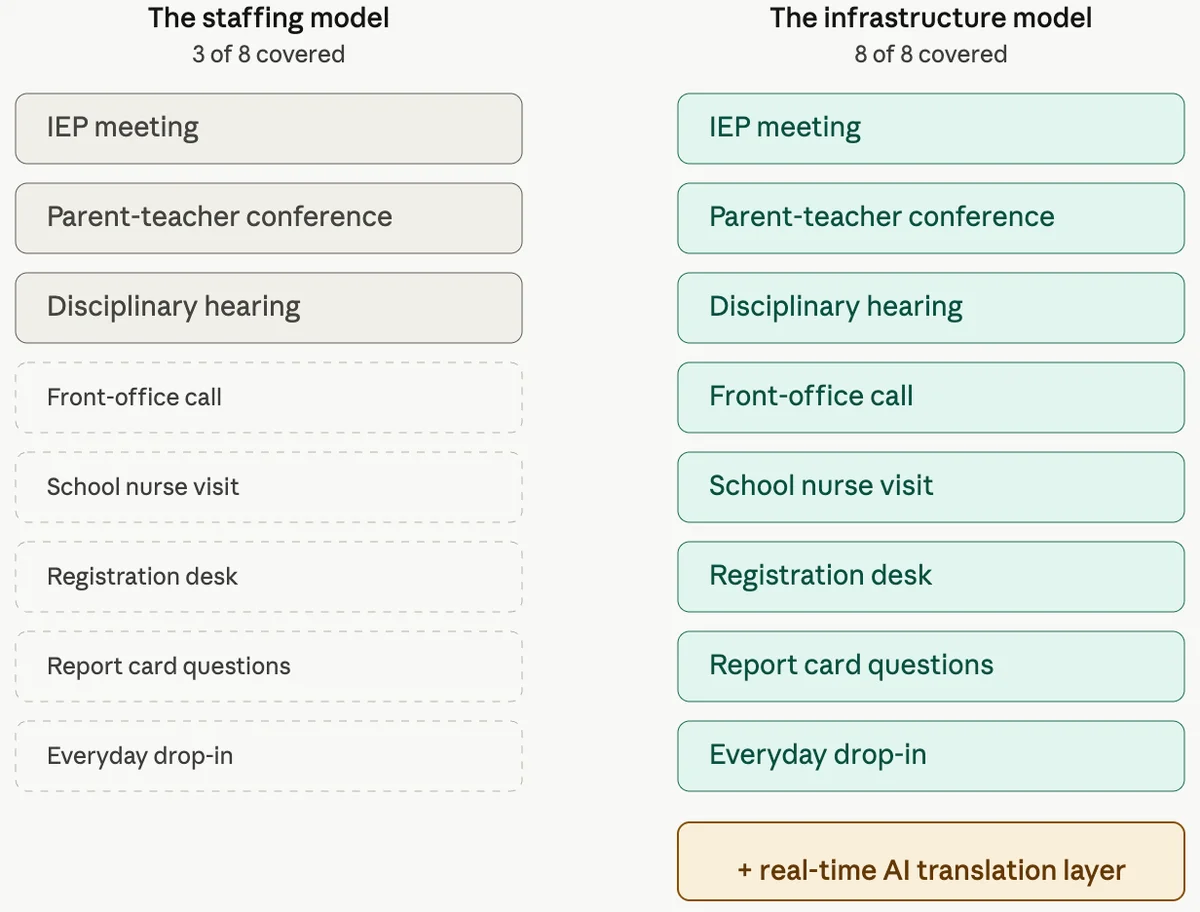
The surface area of language access is the entire school day, not the calendared events. Schedule an interpreter for the IEP meeting and you’ve covered one interaction. The other forty in that family’s school year go untranslated or get patched by whoever is nearby.
Take Greene County Schools in North Carolina, a 2,700-student district where 35.4% of pupils are Hispanic or Latino. Patrick Greene, in his 12th year as principal there, told The 74 Million[3] he has to schedule “more official” meetings, like disciplinary hearings, around the schedule of the district’s lone interpreter. Everything else, nurse calls, daily front-office conversations, the registration desk, the parent who shows up at 3 pm with a question about her kid’s grades, runs on improvisation.
What Schools Actually Pay When There’s No Language Infrastructure
When administrators benchmark language access cost, they look at what they spent on interpreters this year. That number misses most of what’s actually being spent. Four hidden line items make up the workaround tax.
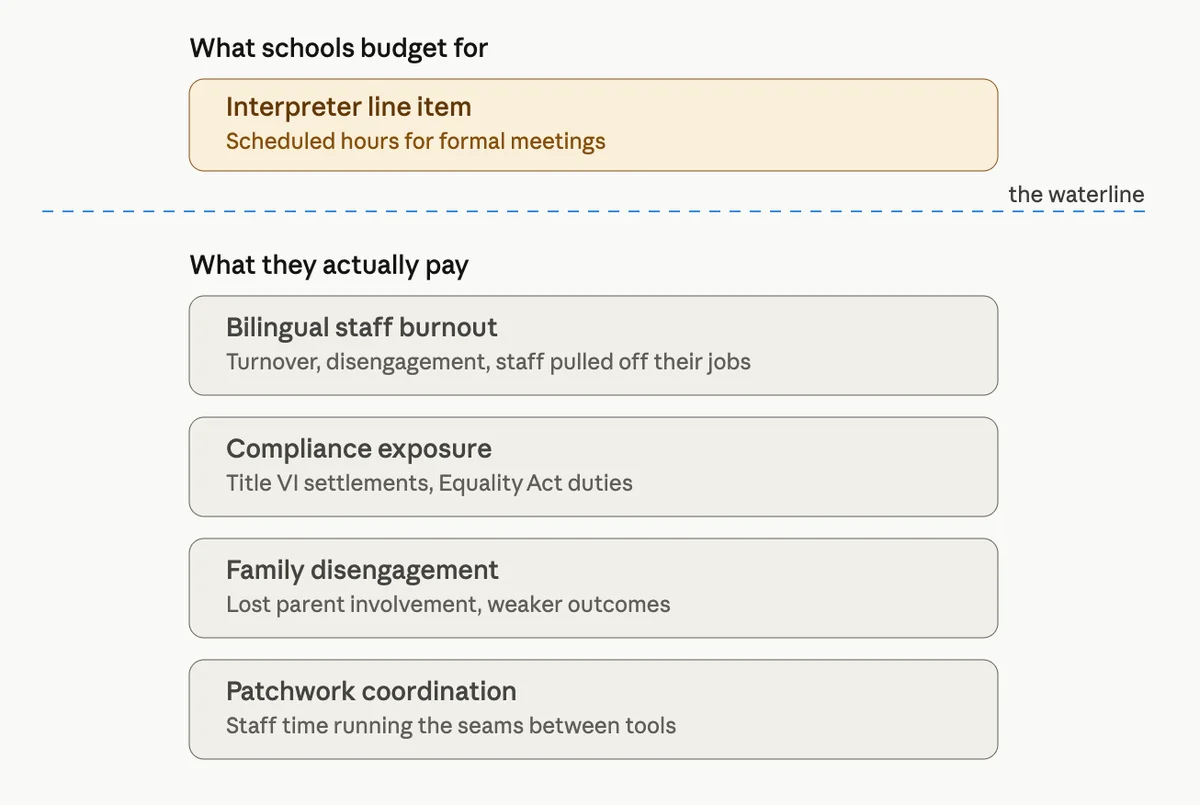
Bilingual Staff Burnout
Karla Vázquez Baur taught for Miami-Dade County Public Schools from 2017 to 2019. She was repeatedly called out of her own classroom to interpret for other teachers’ parent-teacher conferences and parent phone calls. As she told The 74[3], “I did not realize that them calling me down for parent-teacher conferences for other teachers and calling parents for all the different things was against their right.”
In Seattle, the issue reached a breaking point. The Seattle Education Association picketed and delayed the start of school in 2022[4]. One of the demands in the contract they eventually settled: the district had to provide proper interpretation services, so bilingual staff would stop being pulled in to translate outside their actual jobs. A union went on strike to stop the workaround.
That’s the cost showing up where you can see it. The less visible things are the turnover, the disengagement, and the bilingual front-office staffer who, as one advocate described, grew increasingly emotional and began to cry[3] during an expulsion hearing she had no training to interpret.
Compliance Exposure
In the US, Title VI of the Civil Rights Act requires districts to communicate essential information to LEP parents in a language they understand. The Department of Education’s Office for Civil Rights has been explicit about what that means. From a recent OCR letter, schools may violate Title VI when they “rely on students, siblings, friends, or untrained school staff to translate or interpret for parents/guardians” or “fail to provide translation or an interpreter at IEP meetings, parent-teacher conferences, enrollment or career fairs, or disciplinary proceedings.”
This isn’t theoretical. In February 2022, OCR reached a settlement with Dayton Public Schools[5] that required the district to translate registration forms, disciplinary notices, emergency notifications, report cards, IEPs, parent handbooks, and more. The complaint had been filed by Advocates for Basic Legal Equality.
In the UK, schools and universities sit under the Equality Act 2010. Under the Equality Act 2010, once an institution is aware that a language barrier is preventing meaningful participation, failure to implement a practicable adjustment can itself constitute indirect discrimination on grounds of national origin, a principle the courts have applied strictly in analogous duty-to-adjust cases.
Family Disengagement and Student Outcomes
A 2019 meta-analysis in Psychological Bulletin[6] pooled 448 studies covering 480,830 families. It found small but consistent positive associations between parental involvement and student achievement, engagement, and motivation. The point worth dwelling on: those associations held across age groups, ethnicity, and socioeconomic status.
So when language access is rationed to formal events, what gets cut isn’t a nice-to-have. It’s the everyday relationship that the evidence base says actually moves outcomes. The parent who can’t follow up on a behavior note, can’t ask the school nurse why her kid was sent home, can’t decode the report card, isn’t disengaged by choice.
From Patchwork to Infrastructure
Language access infrastructure means treating language access the way you already treat IT or accessibility: an always-on operational layer that’s budgeted, owned by someone, and covering the whole communication surface by default. Not a series of bookings you assemble each time a multilingual family walks in.
Until recently, that was hard and expensive to reach. Always-on coverage meant an interpreter on call for every language, every hour, which no school could afford.
Real-time AI voice translation reaching human-level quality is what changes the math. Even in a demanding test, the gap with human interpreters is smaller than you’d think and closing fast. In a 2025 comprehension study[7], journalists followed either a human interpreter or a leading AI service through a climate press conference; the human group scored 4.5 out of 10, the AI group 3.7, in a high-stakes setting built to expose exactly the kind of nuance AI handles worst.
Studies like this lag the product cycle by a year or more, so the tools available today already sit ahead of that result. For the routine, high-volume conversations that make up most of a school’s day, the front-office call, the nurse’s note, the registration question, real-time AI is now good enough to build on.
That’s what makes the infrastructure shift possible: the tooling underneath it finally works.
Where to Start
- The first move is to map the surface. Which interactions in your school require translation, in what languages, and at what frequency?
- Then look at who is actually doing the work today, interpreters, bilingual staff, Google Translate, and sometimes children.
- Then cost the gap properly: interpreter spend plus staff time plus compliance exposure plus the parent engagement you’re losing. That number is almost always bigger than the line item your board sees.
- Compare the patchwork against always-on. Once you can see the full surface and what it costs to patch, the question becomes whether a real-time tool covering the whole day is cheaper than the patchwork. For most multilingual schools, that math now works in a way it didn’t a few years ago
References
- British Council — Language Trends England 2025.
- NCES — English Learners in Public Schools (Condition of Education).
- The 74 Million — “Left Powerless: Non-English-Speaking Parents Denied Vital Translation Services.”
- Hechinger Report — “Lost in Translation: Parents of Special-Ed Students Who Don’t Speak English Often Left in the Dark.”
- AbleLaw — U.S. Department of Education, Office for Civil Rights settlement with Dayton Public Schools (2022).
- Psychological Bulletin — 2019 meta-analysis (PubMed).
- L@TIC ejournal — 2025 comprehension study.