If you dream of creating jaw-dropping effects for movies or music videos, Kevin Pinga has advice you don’t want to miss.
He is a senior Houdini FX artist with seven years of experience on Hollywood projects. You might have seen his work in Marvel films like Spider-Man: Far From Home and The Thunderbolts, music videos for Taylor Swift and Maroon 5, or TV shows like The Walking Dead and Brooklyn Nine-Nine.
Kevin focuses on visual effects using Houdini, a software that handles simulations, dynamics, and other complex processes.
“To give you an idea of what effects work is, it involves things that are dynamic on screen and very difficult to recreate when shot on set,” he says. “For example, explosions, fire effects, smoke, water effects, tsunamis, and destruction. That’s what I specialise in.”
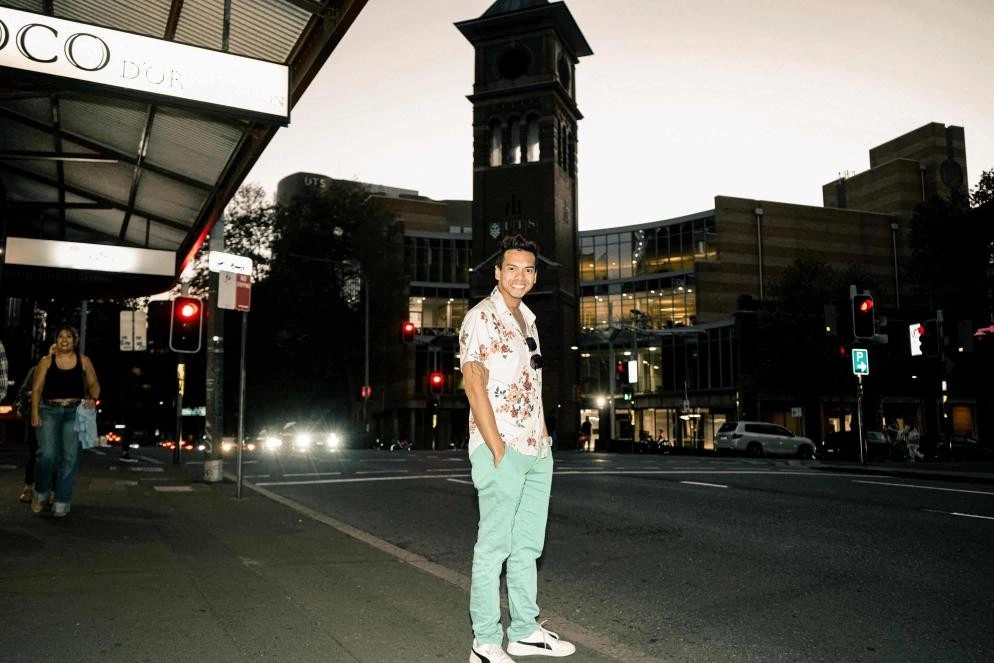
FX artist Kevin Pinga has contributed visual effects to blockbuster films, hit TV series, and global music videos. Source: Kevin Pinga
Prioritise your work, fundamentals, and soft skills
When choosing a VFX programme, Kevin advises focusing on the work first. It’s easy to get caught up in school rankings or awards, but those don’t tell you how intense the training really is. What matters is what the students are creating because that shows the level of skill and creativity you can expect.
“For example, if you want to buy a painting, you look at the paintings and choose one you like,” he says. “You don’t go up to the painter and ask which school they learned painting from. You look at their work and say, “I like this, I’ll buy it.” The same approach should be applied when choosing a school.”
Check the student projects and see if they are impressive. If the work is strong, it doesn’t matter whether the school is small or where it is located. Your real competition is with talented students, not schools with fancy names.
If you want to move from being a student to working on high-profile music videos and major Hollywood productions, your fundamentals are the most important. They don’t have to be perfect, but you need to understand what you’re doing.
A lot of learning happens on the job rather than in school, but a solid base — especially your artistic eye — will carry you far. If you can look at an image, tell what works and what doesn’t, and explain why, then technical skills become tools to strengthen that eye.

Kevin advises students to create original work that showcases creativity and technical ability. Source: Kevin Pinga
Say yes to opportunities that come
Another critical skill is being open to opportunities. Don’t say no just because something seems complicated.
“I know some students who get a project and immediately say, ‘I don’t know how to do this. This is too difficult,” Kevin says. “My advice is to say yes first; the solution will come along the way.”
The same applies to work. “My first few jobs in LA were challenging because I worked at mid-sized companies rather than large studios,” the FX artist says. “These companies didn’t always have a proper hierarchy or clear supervisors and leads who could guide you. A lot of the time, I had to learn things on my own and figure them out myself.”
Communication is just as important. As a junior, it’s easy to avoid admitting you don’t know something, but asking for help early is essential. Being able to solve problems independently while communicating under pressure is what helps you grow.

Presentation matters just as much as technical execution, with lighting, textures, and shading helping effects stand out. Source: Kevin Pinga
The secret to getting noticed by top VFX studios
Getting noticed by international VFX studios can feel tricky if you’re a student outside major hubs. The most important thing you have is your demo reel, because it shows exactly what you can do. Today, being highly specialised in one area often isn’t enough. Studios want artists who can handle multiple skills.
“As a student, your demo reel is essentially your ticket,” Kevin says. “It’s your portfolio and your entry point into the industry.”
However, he admits that the current visual effects climate isn’t very strong, with factors like AI and broader political issues affecting the industry. Even as a senior artist, it’s still challenging for Kevin to find work.
That makes standing out even more critical. Kevin sees a lot of student reels where people follow a tutorial and then include the tutorial output directly in their portfolio.
“I wouldn’t recommend that,” the FX artist says. “The visual effects community is small, and recruiters can usually recognise tutorial-based work immediately. Seeing that often signals that the candidate simply followed instructions rather than created something original.”
Instead, build unique scenes, use your own assets, and focus on presentation. Lighting, textures, and shading matter just as much as your animation. “It’s like having a beautiful car but taking a photo of it with poor lighting and a low-quality camera — it won’t look as good as it could,” Kevin says. “So focus on presenting your work well.”
Social media can also help you share your work and get feedback. Even if your work isn’t perfect yet, posting it allows you to learn and improve. When your reel is ready for applications, keep it under a minute and show only your strongest pieces. Quality always matters more than quantity.

Kevin encourages students who want to be FX artists to embrace challenging projects, saying growth often comes from solving difficult problems. Source: Kevin Pinga
The changing role of the FX artist
The role of an FX artist has changed significantly in recent years. It was once highly specialised, with artists focusing solely on creating effects and then passing them along to other departments for lighting, shading, or compositing. Each person in the pipeline had a clear, narrow responsibility, and collaboration mainly focused on efficiently handing off work.
Today, the role has become more generalist. Studios expect FX artists not only to create effects but also to present them in a way that stands on its own.
“You don’t have to put the entire shot together, but you do need to show, ‘This is my effect against the original plate, it looks good, and it’s cohesive,’” Kevin says. “That way, the next person in the pipeline — whether a compositor or lighter — can use it as a reference and continue the work seamlessly.”
Tools have evolved quickly as well. Many once manual processes are now automated, yet understanding what happens behind the scenes remains critical. Technical skills are increasingly valuable.
FX artists do not need to build complete applications, but a foundation in coding, Linux, and scripting makes them more capable. AI tools can accelerate learning, but knowing the fundamentals gives artists more control over their work and enhances overall quality. Even as automation grows, Kevin believes core knowledge remains essential for producing professional, high-quality effects.