An architect can now train an AI agent, build a world for a video game, study the ecology of a desert, or redesign the way the next generation learns. At the Southern California Institute of Architecture (SCI-Arc), all four can become the focus of a master’s degree. SCI-Arc EDGE, Center for Advanced Studies in Architecture gives you one concentrated year to choose a direction and go deep.
Its four Master of Science (MS) degrees — Architectural Intelligence: AI, Platforms, Automation; Fiction and Entertainment; Synthetic Landscapes; and Design Theory & Pedagogy — each run for three semesters. Individually, they develop specialized expertise. Together, they operate within EDGE’s think-tank model, allowing ideas to travel between students.
That exchange can begin with people who have taken very different routes to SCI-Arc. All degree holders are welcome, including those coming from outside architecture. All four programs are also STEM-designated, allowing eligible international graduates to pursue a 24-month STEM OPT extension following standard post-completion OPT.
Then there is Los Angeles (LA). This is a city that builds worlds for screens and cities in real life, with the LA River running through the middle, and some of California’s most striking landscapes providing real terrain for questions about ecology, infrastructure, and climate.
You could spend years watching these territories evolve. At SCI-Arc, you only need one year to learn how you can shape them.
Turn machine intelligence into architecture
Anyone can type a prompt. SCI-Arc’s MS in Architectural Intelligence: AI, Platforms, Automation goes much further into what happens after you press enter.
You’ll explore three core territories: sensing and analysis, generation and automation, and interface and mediation. During the fall semester, you’ll develop architectural projects entirely through AI-driven and intelligent-agent pipelines, responding to 3D-scanned real-world sites. From there, you’ll move towards increasingly independent research and the development of original applications.
The toolkit you’ll leave with stretches across coding, machine learning, generative and analytical AI development, LiDAR and other sensing technologies, XR development and robotic fabrication.

At SCI-Arc, specialized study happens within a culture of exchange, critique and experimentation. Source: Southern California Institute of Architecture
Enter the worldbuilding business
The MS in Fiction and Entertainment gives architects, designers and other creative thinkers a year to explore spaces that begin with a story.
You’ll work across worldbuilding, storytelling, and production, with each semester advancing a year-long thesis. The final work can take the form of a short film, animation, music video, documentary, video game, VR environment, theatre experience or performance.
The program sits comfortably in its surroundings. Fiction and Entertainment are deeply embedded in the LA entertainment industry. Expect to encounter professionals working across film, game development, commercial production, visual effects and other design industries. SCI-Arc has collaborated with companies such as Framestore, Disney Imagineering, Netflix, Digital Domain, and the Sundance Institute.
This explains why recent graduates have easily moved into production design, creative direction, video games, VFX, commercial and television production, media art, and design research.
California as your laboratory
Pursue the MS in Synthetic Landscapes and California’s agricultural heartland, the Central Valley, or the rugged Central Coast could become sites of investigation.
The program brings architecture, landscape, urbanism, and ecology together to explore how humans inhabit environments they have already transformed. You’ll start in LA, investigating urban ecology and the relationship between natural systems and infrastructure. Fieldwork then expands into California’s rural landscapes, where environmental systems can be observed at dramatically different scales.
Those observations return to SCI-Arc’s studios and fabrication facilities. Computational research, coding, machine learning, sensing, robotics, CNC machining, and 3D fabrication give you ways to analyze environmental conditions and prototype new responses to them.
That means a river can become a research question. A desert can become a testing ground. A landscape can even be examined as ecology, infrastructure, technology, and design at once.
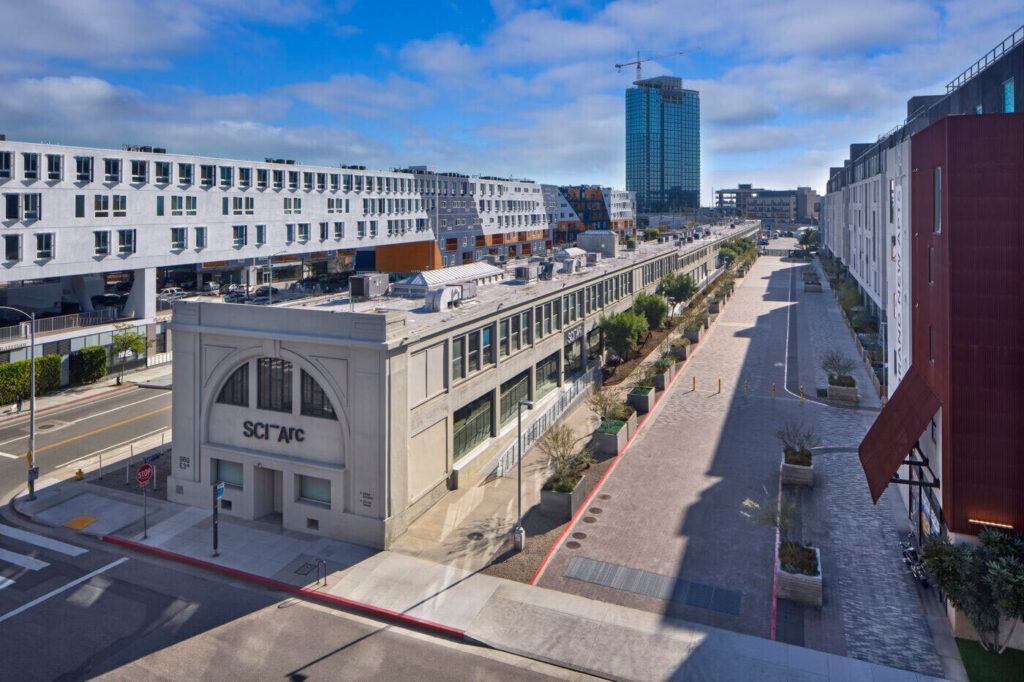
From its Los Angeles campus, SCI-Arc turns the city and California beyond it into territory for experimentation. Source: Southern California Institute of Architecture
Design the studio itself
The MS in Design Theory & Pedagogy gives future educators three semesters to explore how architecture can be taught, discussed, and shared as the discipline evolves.
You’ll research and experiment with new models for design education. Projects can engage subjects including AI and machine learning, climate change, material innovation, and the politics of design.
Ideas also have to become usable. Expect to develop curricula, course frameworks and pedagogical approaches; communicate through writing and public speaking; create exhibitions and curatorial projects; and translate complex theory into spatial, visual and digital forms. The program even extends beyond SCI-Arc through faculty and advisors connected to institutions like UCLA and the Getty Research Institute.
What will you make of a year? Pick your path today.