Tianqi Zhao is a PhD candidate in epidemiology at the University of Alberta, specializing in climate change and mental health. Her research focuses on the impacts of climate change on global mental health, with particular attention to health inequities among Black, racialized and other vulnerable populations. In 2024, she was awarded the International Development Research Centre (IDRC) International Doctoral Research Award, which supported three months of field research in the Western Cape, South Africa. In partnership with a local NGO, communities and researchers, her fieldwork examined the relationship between extreme heat exposure and depression among South African adults in rural areas, while also exploring how food insecurity and sleep quality shape mental health outcomes as mediators. She spoke to University Affairs about her research.
Q: You completed your field research in South Africa earlier this year. Could you describe the nature of the fieldwork you conducted there?
A: My doctoral research examines the relationship between extreme heat exposure and depression in rural Western Cape, South Africa, and specifically whether that relationship operates through food insecurity and disrupted sleep. The Western Cape, where I conducted my fieldwork, is one of the regions most acutely affected by rising temperatures on the continent, and it is home to fishing communities that are economically marginalized and have very limited resources to adapt to a changing climate. That combination made it both a scientifically compelling and deeply human context for this work.
The fieldwork itself involved in-person questionnaire interviews with community members across three rural coastal communities: Diazville (Saldanha), Laingville (St. Helena Bay), and Louwville (Vredenburg). I worked alongside local data collectors who were recruited through our partner NGO, SPHER3, each of whom interviewed members of their own communities. I travelled between sites to conduct interviews directly and provide supervision and support throughout the data collection period, which ran from November through December 2025, with a follow-up round completed by phone from Canada in early 2026.
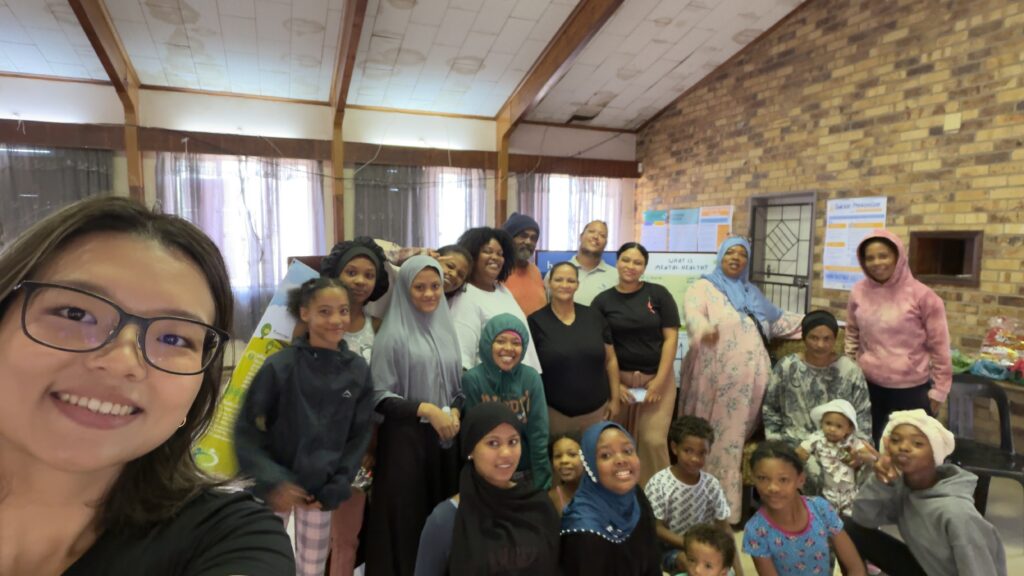
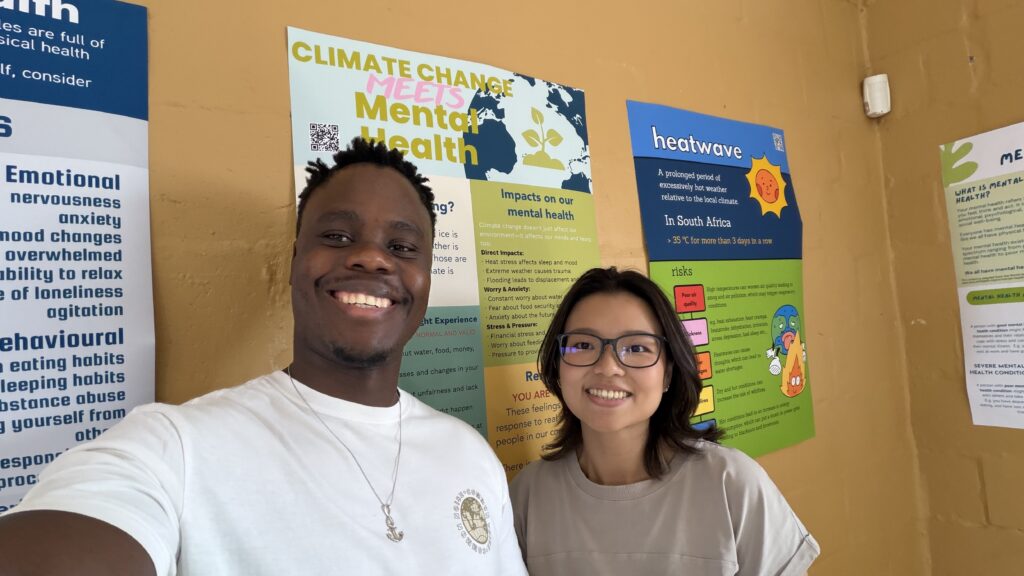
Because this was community-based research, I also felt a responsibility to give something back to the communities that opened their doors to us. In January 2026, before leaving South Africa, I hosted health education sessions in Laingville and Hopland focused on climate change and mental health, translating what the research was about into accessible, practical information for the people living it every day. For me, that was not an afterthought. Research that stays locked inside academic journals does not change the conditions people are living under.
Q: What was a key highlight from your fieldwork experience?
A: The highlight that stands out most is what I learned about building trust in community-based research, and how much deliberate work that requires before a single interview takes place.
I am Chinese South African, and walking into rural Western Cape communities, I was aware that I did not visually fit the picture of someone the community would automatically open up to. Trust had to be earned, and I thought carefully about how to structure the research so that it was not built on my presence alone. Before fieldwork began, I established a community advisory group with SPHER3 to ensure local voices shaped how the study was conducted. I recruited data collectors from within the communities themselves, people who already had relationships and credibility with their neighbours, and had them conduct the interviews rather than doing it all myself.
But I also did not want to remain at a distance. I went house to house with the data collectors, not to every household, but enough to introduce myself, explain the research, and show that I was genuinely present and accountable. Those visits taught me more than I expected. The data collectors became my entry point into the community, and the relationships I built with them shaped how I understood the context in ways that no questionnaire could capture on its own. I listened, I asked questions, and I let myself be guided by people who knew their communities far better than I did.
The health education sessions I hosted at the end of fieldwork were also part of this. Before I left, I brought community members together to talk about climate change and mental health, sharing information that was directly relevant to their lives. That was my way of showing that the relationship was not one-directional. The community gave me their time, their stories and their trust. The least I could do was give something meaningful back before I boarded a plane back to Canada.
That experience reinforced something I now carry into all of my research: community trust is not a checkbox. It is an ongoing relationship that has to be tended to, and the quality of the science depends on it.
Q: What aspects of your experience did you find most surprising, and what were the greatest challenges you faced?
A: The most surprising and fulfilling moment of the entire fieldwork was seeing how genuinely interested people were in the health education sessions. I had not anticipated the level of engagement, and what struck me most was the children. Many parents brought their kids along, and rather than sitting quietly at the back, the children were curious, attentive and fully present throughout. At the end of one session I asked them what they had learned about climate change and mental health. One child said that when it is hot while playing soccer, you need to drink more water. Another said that when you feel sad, you should talk to your friends. Hearing those answers, I felt something shift in me. These children had taken complex ideas about environmental health and emotional well-being and made them their own, in the most natural and human way possible. That moment made the entire journey feel worthwhile.
The challenges were real as well. Administrative and safety processes were far more demanding than I had anticipated. Navigating ethics approvals, research permissions and institutional requirements across two countries added layers of complexity that took significant time and energy to manage. On the ground, safety was a constant consideration. Working in under-resourced communities requires careful planning, local knowledge and ongoing vigilance, and there were moments where the unexpected required quick and careful judgment. These were not small setbacks, but they taught me that adaptive thinking and strong community partnerships are not just helpful in fieldwork. They are essential.
Q: How did this fieldwork shape your understanding of your research topic or approach?
A: The moment that most profoundly reshaped how I think about research happened during an interview with a participant who was herself a social worker. She was familiar with how research works, and after I finished interviewing her she turned the conversation around and asked me directly: you now have my data, you can see that we struggle with food insecurity, that we are depressed. What happens next? What do I get out of this now?
I was speechless. I had answers I could have given. We will publish the findings. We will advocate for your community. We will share the evidence with policymakers. But in that moment, none of those answers felt adequate, because she was not asking about what might happen in five years after the journal articles are written and the policy briefs are circulated. She was asking about now. And I had nothing to offer her for now.
I left that conversation feeling a deep sense of shame, and I have carried it with me since. It forced me to honestly reckon with the gap between academic research timelines and the urgency of people’s lived realities. Communities like hers cannot wait years for structural change that may or may not come. That conversation made me question whether producing knowledge alone is enough, and the honest answer is that for me, it is not.
It has strongly shaped the direction I want to take as a researcher. I am increasingly committed not just to community-based research but to intervention research, work that brings something tangible to the table immediately, not only after the findings are published. I want to build research programs where communities see the benefit during the process, not only at the end of it, if at all.
Q: How do you plan to share or disseminate the knowledge and insights gained from your fieldwork with academic, professional, or local communities?
A: Dissemination happens at multiple levels for me, and I think about each audience differently.
On the academic side, the findings from this fieldwork will form the core of my doctoral dissertation, which I am working toward completing and defending in early 2027. I am also developing the results into peer-reviewed manuscripts and will present related work at international conferences. I am increasingly involved in African research communities, particularly through networks connected to the University of the Witwatersrand and the South Africa Human Science Research Council, and I see those spaces as especially important venues for sharing this work. Research on African communities should be visible and discussed within Africa, not only in North American and European academic circles.
Beyond academia, I am committed to making the findings useful to the people and systems most affected. Together with my collaborators at SPHER3 and the University of the Witwatersrand, we plan to share results with community partners and local health stakeholders in the Western Cape in ways that are accessible and actionable. I also see the health education sessions I delivered during fieldwork as a model I want to build on, returning findings to communities in formats they can actually use rather than documents that sit behind journal paywalls.
At the policy level, the goal is to contribute evidence that informs how South Africa and other countries in the Global South respond to the intersection of climate change and mental health. This is an area where the research gap is significant and the stakes are high, and I feel a responsibility to make sure the voices of the communities I worked with are part of that conversation.
Q: What are your next steps, and how do you plan to build on this fieldwork experience?
A: My immediate next step is completing my dissertation, which I am on track to defend in early 2027. The findings from this fieldwork are central to that work, and I want to make sure they are written up with the care and rigour they deserve before I move to the next stage.
One of the most valuable outcomes of this fieldwork has been the relationships and networks I have built with South African researchers and research councils. Those connections are already bearing fruit. I am currently working with collaborators at the University of the Witwatersrand and other South African institutions on new projects that build directly on what we started together, and I am genuinely excited about where that work is heading. These are not peripheral collaborations. They are partnerships I intend to invest in and grow over the course of my career.
From there, I plan to pursue a postdoctoral position that allows me to deepen and expand this line of research. My long-term vision is to build a research program rooted in African and African immigrant communities, examining how climate and environmental exposures shape mental health outcomes among people who are already navigating significant structural disadvantages. Having lived in South Africa for seven years and conducted research there, I carry both a personal and professional connection to these communities, and I want that connection to remain at the centre of my work rather than becoming a footnote in a career that drifts toward more convenient research contexts.
I am also increasingly interested in how these questions play out among African diaspora communities here in Canada, particularly in cities like Edmonton where I am based. Climate vulnerability does not end at the border, and the mental health challenges facing African immigrants are shaped by environmental, social and structural forces that my research is well positioned to examine. But I do not want to stop at documenting those challenges. I want to develop and test community-based mental health initiatives that genuinely empower people, programs that communities can take ownership of and that produce visible, tangible benefits rather than simply adding to a body of literature.
Achieving that kind of impact requires working across disciplines. Climate change, mental health, food security, migration and community resilience cannot be understood through a single lens, and I am committed to building interdisciplinary collaborations that bring together epidemiologists, environmental scientists, social workers, psychologists and community organizations. The most meaningful research I can imagine doing sits at the intersection of all of these fields, and I want to help create the infrastructure for that kind of work to thrive.
Staying in academia matters to me not only for the research itself but for what it makes possible in terms of mentorship. I want to train the next generation of researchers, particularly those from equity-seeking and underrepresented backgrounds, and help create research environments where diverse perspectives are not just welcomed but genuinely valued. The researcher who asked me what she was getting out of my study taught me something important about accountability. I want to pass that lesson on.
The post Heat waves and brain waves appeared first on University Affairs.